Showing posts with label intercultural. Show all posts

Monday, March 2, 2020

Out to build bridges - Storytelling time

I come from a long line of pioneers, builders of bridges between people, and so - privately and professionally, in intercultural communication and change management - this is what I love doing, and what I do best.

My Great-Grandmother built bridges half around the world with courage, my Grandfather survived Siberia building bridges with music and my Mother built bridges between people all her life with human kindness. Let’s start by telling the story of my Great-Grandmother, from whom I got a keepsake, a family heirloom, a coin that you have probably seen me wearing, because I wear it each day every day – for example in this picture.

It shows a fantastic bird on a tree spreading its wings and tail, a bird of paradise native to New Guinea on the other half of the globe, just north of Australia. It’s a Five Deutschmark coin from 1894. Germany, compared to other nations, had relatively few colonies and for a time, half of New Guinea was one of them.


My Great-Grandmother, when she was 22, packed a trunk and a travel-harmonium, boarded a ship and set out to Papua New Guinea to marry her fiancé, my Great-Grandfather, who, I believe, was building bridges – ok, it may have been buildings too – as a construction engineer.

She settled with her newly-wed husband in their home, cultivated the garden “everything was so fertile, you just had to squeeze a tomato to have instant fruits from the vine”, she’d tell us when I was little, and she had six children, five of whom survived to adulthood – a good quota in those days –, and her first-born was my Grandfather. I remember childhood pictures of him, produced on metal plates, riding a huge tortoise in the front yard, which consisted of enormous palm trees and ferns in front of a quaint Victorian house.

Because my Great-Grandmother was a very pious woman, she bonded with the native population by playing them religious songs on her harmonium, which is something that works like an accordion, but the size of a chest of drawers and powered by air pumped through pedals. 

A lush life, perhaps, but very different from what she had left behind. After World War I, the German part of the island was given to Australia and she and her family moved back to Germany.

Whenever I think of the life she must have lived I can’t help thinking how courageous and adventurous she was, moving so far away from everything that she knew at a young age, leaving family members and friends behind, at a time where travel – and letters - took weeks on end by boat, no phone connection, without our post-modern conveniences of wifi, mobiles, pads and pods and instant connection.

And maybe part of that is why I relocated to Canada. I’ve come to think that after the fact, really. Sure, the differences between a Canadian and German life may be smaller, but, hey, living in the prairies has its own challenges, some of which you quickly learn when you buy boots and coats that are -40 degrees Celsius proof.

I’ve been here for 10 years now, and over the years, thinking about my Great-Grandmother definitely helped me be stubborn and resilient on one hand and open-minded on the other, and I am proud to be able to bond with people, building bridges on the foundation of courageousness, music and human kindness.

Saturday, August 8, 2015

Why Enterprise Architects are vital for Change Management - Part 1: What is EA anyway?

As a Manager of Organizational Change I have come to appreciate working with technology sources tremendously, in particular with Enterprise Architects. In my previous career as an expert for Organizational Communication & Development - working in lighthouse/pioneer projects and transitions of large corporate M&As long before this was even called change management - I had known IT people from some assignments facilitating teams, or teaching MBAs. When I got deeper into the IT world some 10+ years ago I remember thinking two thoughts:
  • Wow. This is a completely separate culture within companies, much different from all other departments, you won't get anywhere in here without speaking what I affectionately call 'Geekspeak' (Watching 'The IT-Crowd' does help to overcome the culture clash, though..).
  • And secondly, among my colleagues & friends or the (IT) Change Management Group at gpm-ipma, Germany's largest PM association, we absolutely agreed: If Change in Organizations goes wrong, it's almost always a "people problem".
I would like to reflect my view on this world back to you, maybe provide you with some fresh insights, and I'll start with the definition of Enterprise Architecture. There should really not be too many problems here, one could always look up wikipedia (how I dread the day I find out wikipedia is blatantly incorrect - always cross-check, boys & girls), or use common-sense.

Do companies know what to look for in an Enterprise Architect?

Flipping through companies' job postings, however, on the requirements side, one finds some must-haves that clearly display lack of ability to think on a metalevel. Partly, to be sure, because it makes measuring or filtering candidates' skills difficult.
Taking the term 'Architect' as a metaphor might be helpful. An Architect plans & monitors the building process of a house, she needs to know about plumbing or electrician requirements, yet doesn't have to be a plumber or electrician herself (*or himself - men are obviously included ;). Of course some time way back in her learning phase there might have been an internship, apprenticeship or practical studies field.
Back to Enterprise Architects and the metalevel. If an EA only needs to know ABOUT administrating systems, writing code etc. how can one assess if her skills are enough for a sophisticated job such as planning a business, its processes and technology?

I hear "Ask an expert" from the 3rd row. I am thus flinging this question to you, the experts among you. What criteria for skills and methods of Enterprise Architecture are indispensable to you, which parts do you value most? Is it more business or more techie or 50:50? How would you separate myth from reality? What are the obstacles in the daily routine? What difference does project management methodology contribute, scrum or waterfall?


I'd appreciate your input, to get a discussion going. Cheers!

And since I love thinking in terms of questions, here are the ones the next part(s) will revolve around: How does Enterprise Architecture relate to the many other Architecture job titles that seem to be in blooming season? Solution(s) Architect, Data Architect, Information Architect, Business Architect.. And what makes it invaluable for Change Managers to work closely with Enterprise Architects to ensure the success of the project?
Tune in..

Sunday, March 15, 2015

Intercultural Competences in Change Management

Intercultural Competences in Change Management

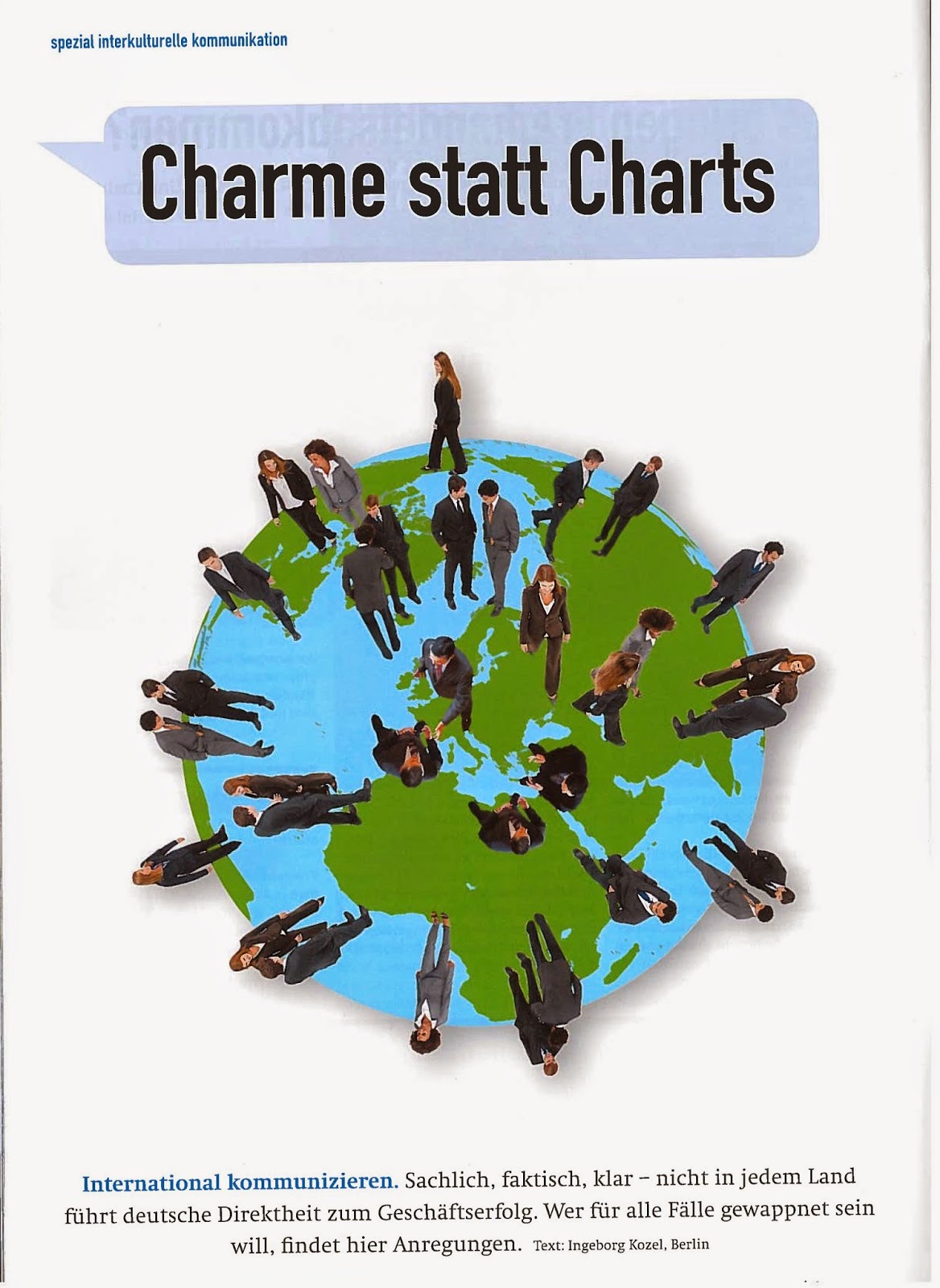
Try Charms, not Charts

Today's projects are often made up of international members. And while collaboration has a fair chance when international people of the same designation work together, problems multiply when the road gets rocky, which is not altogether unlikely in Change Projects.

This article contains an interview with me on best practice tips to avoid pitfalls intercultural business communication.
http://www.gtai.de/GTAI/Navigation/DE/Meta/Presse/Markets/Markets-international/Ausgaben-2014/markets-international-ausgabe-2014-05,t=charme-statt-charts,did=1125488.html
To summarize the German language article: Taking up cross cultural business relationships can comparable to courtship in various cultures - different rituals may be required in different countries, and while Germans tend to be straightforward, good planners and drill down to the fact of the matter immediately, they should focus on small talk bonding more often, turn on their charm, and linger on the level of business relationships a little bit longer.
Cross cultural communication means respecting others' values and behaviours without bending over backwards.
Last but not least, - "What are you ssinking about?" https://www.youtube.com/watch?v=MLoYL-6Y6vg - a sense of humour helps to weather storms and navigate around cliffs in cross cultural collaboration.

Tuesday, July 10, 2007

Competitive edge in Diversity: Female project management experts take off

On 09 July 2007,  Entrepreneuresses and female project managers from all over Germany met at the Frankfurt “Cosmopolitan” on invitation of Roswitha Müller-Ettrich (Munich, founding member and Head of the Board of Trustees of the GPM, (German project management association-IPMA) and Dr. Dorothee Feldmüller (Bochum, IT-project management and consulting; Leaders’ Team of GPM Chapter Dortmund). 

Dr. Katharina Kettner took part in the newly founded GPM work group as an associated expert for Diversity and Inclusion.

Strategic objective is the creating space for themes of gender within project management, and will be basis for enhancing collaboration and effectiveness in project management work by diversity, as well as tackling questions of marketing achievements, image and profile, for example by means of success stories.
Talking about successes and failures is an important element of future oriented management. Diversity belongs to the field of intercultural competencens, by which added value can be improved in many projects. Contrarily, ignoring cross cultural differences not only wastes nerves, but also assignments, time and money.

Wednesday, May 19, 2004

2004 Pflege und Pflegewissenschaft - Ausbildung, Berufspraxis und Kultur im internationalen Vergleich

23.-27. Mai 2004 - London, UK

In einer Exkursion nach London entdeckt eine Studiengruppe der Ev. Fachhochschule Rheinland Westfalen Lippe die 'Roots of Nursing and Care Culture' mit Dr. Katharina Kettner.

Die "Medical History Tour" umfasst interessante Themen wie "Operations without Anaesthetics" im Old Operating Theatre & Herb Garret, oder "The Early Hospitals", "Body Snatchers" im St Bartholomew's Hospital Museum in Smithfield

Neben kulturell orientierten Entdeckungsgängen durch die pulsierende Stadt - und natürlich auch Camden und andere Märkte ;), wird sicherlich ein besonderes Highlight das interkulturelle Erlebnis sein: Wie Kollegen in einem anderen europäischen Land leben und arbeiten, sowie der Vortrag über (universitäre) Ausbildung in Großbritannien "The provision of nurse education in the UK", Florence Nightingale College for Nursing and Midwifery, King's College.

Nursing & Care - Comparing Education, Vocational Practice and Cultures Internationally

23 - 27 May 2004 - London, UK

In an excursion to London a group of students of the Ev. Fachhochschule Rheinland Westfalen Lippe (University of Applied Science) will discover the 'Roots of Nursing and Care Culture', led by Dr. Katharina Kettner.

Next to interesting topics like "Operations without Anaesthetics" at the "Old Operating Theatre & Herb Garret" or "Early Hospitals", "Body Snatchers" at St Bartholomew's Hospital Museum in Smithfield - part of the "Medical History" tour -, next to cultural walks and explorations through that vibrant city, including Camden and other markets ;)

A particular highlight will surely be the intercultural experience, to see how colleagues work and live in another European country and a talk and discussion about "The provision of nurse education in the UK", at the Florence Nightingale College for Nursing and Midwifery, King's College.