Showing posts with label Change Management. Show all posts

Monday, March 2, 2020

Out to build bridges - Storytelling time

I come from a long line of pioneers, builders of bridges between people, and so - privately and professionally, in intercultural communication and change management - this is what I love doing, and what I do best.

My Great-Grandmother built bridges half around the world with courage, my Grandfather survived Siberia building bridges with music and my Mother built bridges between people all her life with human kindness. Let’s start by telling the story of my Great-Grandmother, from whom I got a keepsake, a family heirloom, a coin that you have probably seen me wearing, because I wear it each day every day – for example in this picture.

It shows a fantastic bird on a tree spreading its wings and tail, a bird of paradise native to New Guinea on the other half of the globe, just north of Australia. It’s a Five Deutschmark coin from 1894. Germany, compared to other nations, had relatively few colonies and for a time, half of New Guinea was one of them.


My Great-Grandmother, when she was 22, packed a trunk and a travel-harmonium, boarded a ship and set out to Papua New Guinea to marry her fiancé, my Great-Grandfather, who, I believe, was building bridges – ok, it may have been buildings too – as a construction engineer.

She settled with her newly-wed husband in their home, cultivated the garden “everything was so fertile, you just had to squeeze a tomato to have instant fruits from the vine”, she’d tell us when I was little, and she had six children, five of whom survived to adulthood – a good quota in those days –, and her first-born was my Grandfather. I remember childhood pictures of him, produced on metal plates, riding a huge tortoise in the front yard, which consisted of enormous palm trees and ferns in front of a quaint Victorian house.

Because my Great-Grandmother was a very pious woman, she bonded with the native population by playing them religious songs on her harmonium, which is something that works like an accordion, but the size of a chest of drawers and powered by air pumped through pedals. 

A lush life, perhaps, but very different from what she had left behind. After World War I, the German part of the island was given to Australia and she and her family moved back to Germany.

Whenever I think of the life she must have lived I can’t help thinking how courageous and adventurous she was, moving so far away from everything that she knew at a young age, leaving family members and friends behind, at a time where travel – and letters - took weeks on end by boat, no phone connection, without our post-modern conveniences of wifi, mobiles, pads and pods and instant connection.

And maybe part of that is why I relocated to Canada. I’ve come to think that after the fact, really. Sure, the differences between a Canadian and German life may be smaller, but, hey, living in the prairies has its own challenges, some of which you quickly learn when you buy boots and coats that are -40 degrees Celsius proof.

I’ve been here for 10 years now, and over the years, thinking about my Great-Grandmother definitely helped me be stubborn and resilient on one hand and open-minded on the other, and I am proud to be able to bond with people, building bridges on the foundation of courageousness, music and human kindness.

Wednesday, March 27, 2019

A session of pop-up coaching could benefit you if..

Pop-up coaching is a one-off session of talking with a professional who may or may not be knowledgable in your field, but definitely knows about structures, has experience in corporate life and business and can be a sounding board and neutral advisor for your issues.

You are likely to benefit from a one-time coaching session if you want to..

- set goals in your personal and individual life and need some reinforcement
- check if you're on the right track with your goals and endeavours
- solve a conflict or dilemma that has come up in one of your projects or teams
- get a better grip on the changes happening in your organization, department, team or project, be it as a Sponsor or as an affected Stakeholder, or as a Change Management team
- test if coaching is something that may generally help you in your career, or find out if you are compatible with a particular coach

It is usually a low-risk investment of time and money that can pay off immensely.
Book a session to try it out!

Wednesday, December 26, 2018

So this is Christmas, and what have we done? On Change Monitoring

The time between Christmas and New Year is traditionally used as an opportunity to escape the hustle and bustle of our busy days, take a step back and reflect where you have been and where you are going.

For Change Management, this is even more of a necessity. As an Organizational Change Manager, whether you’re in the “old-fashioned” mode of ‘change after change’ or in a culture of ‘multiple clashing changes’, there are some essential questions that you need to ask yourself:
-      Is our change process still on track?
-      Have any of the conditions changed? Were they fundamental to our plans? Do we have new drivers, change agents, bottle necks or road blocks? Have new goals and objectives emerged? Are corrections necessary?
In order to answer these questions systematically – yes, organizational change management is not only systemic and intuitive, but also a systematic process – it makes sense to have concrete measurements and a description of the initial and future state so that you can
-      Describe and measure the interim state
-      Compare the interim state with your change plans
-      Correct and manage your change plans
This may sound trivial. However, in my experience sponsors in organizations that are undergoing change– for various reasons - often prove to be resistant to measuring and assessing organizational change at the beginning of initiatives, so monitoring and assessments should be the first order of the business when aligning sponsorship buy-in from the get-go.

Finally, what John and Yoko had in mind when they recorded one of the most iconic Christmas song in pop culture https://www.youtube.com/watch?v=Zr9EOFuuIk4was obviously not change monitoring. But it was about reflecting the state of the world and the energy and actions that each of us can take to improve the state of the world we live in, so that it can evolve in a positive way, every day.

-->
Merry Christmas!

Friday, December 21, 2018

In with the New! 7 Signs that your organization/team is ready for agile Part 1


Is your organization ready for AGILE? Here are 3 of 7 signs.

1.     They can make mistakes
2.     They can facilitate 
3.     They can delegate

They can make mistakes When economic pressure builds, leaders and managers tend to have less failure tolerance. As any athlete or musician can tell you, it takes a lot of practising to internalize a new technique, move or team strategy, especially if they’re complex. Practicing is listening to your mistakes!

They can facilitate Agile is very much based on the art of open facilitation. This is not just about the ability of the Scrum Master or Agile Coach and a far cry from the misconception ‘we don’t have a project plan, we’re kind of agile’. Open facilitation evolved in the 60ies and 70ies with tools and methods such as World Café, Open Space and Visualization techniques. As Agile expert Eric Rapin says “A Scrum Master is a Zamboni”. An Agile Coach does not push his/her own agenda!

They can delegate On the flip side of the coin delegating requires trust and openness too. Sponsors are open to delegating the process to agile as a methodology, and Product Owners know how to apply the right dosis of support and involvement with the team and letting the team organize and get on with it themselves. Delegating openly means letting the team members' expertise shine!

See you on the other side ;) Happy solstice!!

Sunday, March 15, 2015

Intercultural Competences in Change Management

Intercultural Competences in Change Management

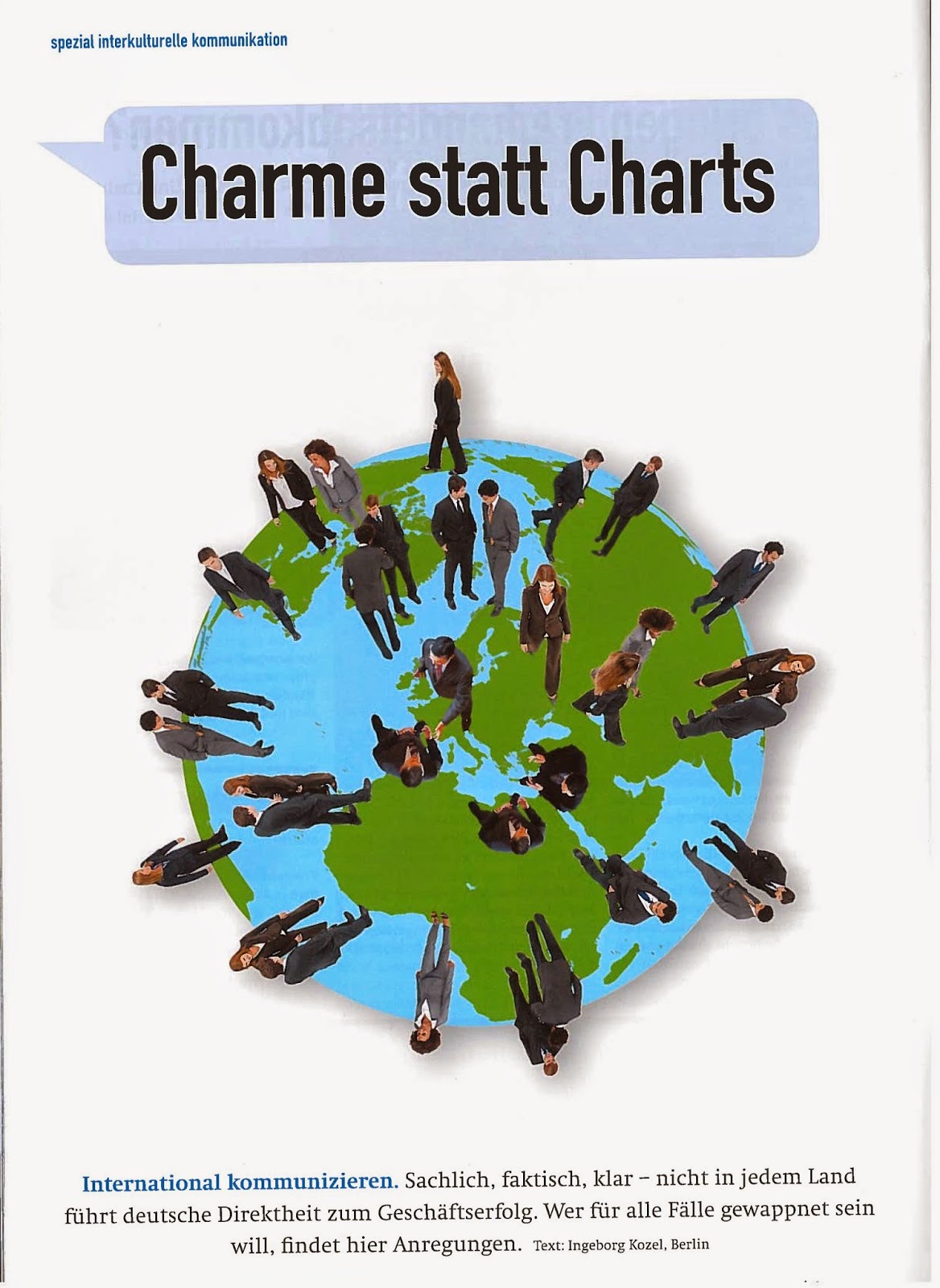
Try Charms, not Charts

Today's projects are often made up of international members. And while collaboration has a fair chance when international people of the same designation work together, problems multiply when the road gets rocky, which is not altogether unlikely in Change Projects.

This article contains an interview with me on best practice tips to avoid pitfalls intercultural business communication.
http://www.gtai.de/GTAI/Navigation/DE/Meta/Presse/Markets/Markets-international/Ausgaben-2014/markets-international-ausgabe-2014-05,t=charme-statt-charts,did=1125488.html
To summarize the German language article: Taking up cross cultural business relationships can comparable to courtship in various cultures - different rituals may be required in different countries, and while Germans tend to be straightforward, good planners and drill down to the fact of the matter immediately, they should focus on small talk bonding more often, turn on their charm, and linger on the level of business relationships a little bit longer.
Cross cultural communication means respecting others' values and behaviours without bending over backwards.
Last but not least, - "What are you ssinking about?" https://www.youtube.com/watch?v=MLoYL-6Y6vg - a sense of humour helps to weather storms and navigate around cliffs in cross cultural collaboration.

Wednesday, July 9, 2014

World Cup 2014 Semi-Final - Learning points for OCM

Germany - Brazil 7-1, a spectacular match - What can we learn from it?


Like in the corporate world, the pressure is on. Because they are condensed to the max, and success and failure are so measurably apparent, joint efforts such as football matches - and music concerts - serve as good examples on how we do in Organizational Change and what the big points are.

Agility & Team spirit

From the beginning right through to the very end the German players were agile and purposeful, they kept eye contact with the others on the team, they were able to let go and pass the ball to a team-mate in orchestrated choreographies, each team member doing their part but also keeping an eye out for the whole.
For a change project in the corporate environment this means that the information flow needs to keep going. Communication channels within the project / project office have to have the necessary definition to spur purposeful action, and at the same time enough openness to keep the teams motivated.
Even in large corporate companies, or even in Tech Consultancies, as many colleagues have confirmed in 'shop talks', there is often no - or not enough - culture of communicating with each other, and social/knowledge management apps are often merely a sad document grave. 
And if this is in the change project teams themselves - how can the word be spread out to the company?

Freedom & Responsibility

Teams need leeway to act on opportunities & synergies, in football and in corporate life. Overcautious micro-management only displays lack of trust, and kills motivation and 'enablement'. 
Participative leadership means team players can grasp opportunities, or create synergies, in OCM for example with SMEs, or the communications or organizational development departments, to optimize success.
It also means they will be able - and willing - to take responsibility and take charge of emerging needs. In the semi-final for example, the 3-0 was scored, because ".. There are lots of defenders in there but nobody is taking responsibility to pick anyone up." (Rio Ferdinand, in the BBC Analysis of the match).

Strategy & "Setting the Course" from the get-go

First of all: Having a Strategy is good. Change has become such a big issue, spanning whole organizations, so it becomes more and more apparent that OCM, as well as Organizational Communication & Culture are STRATEGIC issues. Yes, the ROI is not as easily measured as the goals and chances in football, but if you look at any successful initiative they will have had a STRATEGY on change and company culture, and, what's more important, they will have ACTED ON IT.
There is nothing like setting the course from the get-go - in our example scoring 5 goals in the first 29 minutes - to boost the morale of a team, because it takes pressure off the players. Aligned with the overall strategy, this move is likely to foster more success.
In change initiatives, the OCM Lead is often brought in 6, 8, 10 months into the initiative. This does not only not save money, as intended, it also looses the strategic point and the chance to boost motivation on the project tremendously.

Leadership & Lack of Leadership

The 5-0 in our example was scored due to lack of leadership in the other team: ".. the captain, supposed to be the leader, .. has abandoned ship I am afraid. He has disappeared." (Alan Hansen), and "That is embarrassing. When you do that, you are leaving your team-mates in the lurch. As a centre-half, he has to win the ball there." (Rio Ferdinand)
Much more could be said here, watch this spot for blog posts on Leadership topics.

Don't give up

From many examples we know about "not giving up when times get rough", and Oscar's goal in the last minute is one strong demonstration.
However, "not giving up when things go well" is also important. How many times have teams felt safe and leaned back into complacency. And then lost

DO IT

Football is not rocket science. Change Management is not rocket science. What a facebook friend commented on as "the unrelenting efficiency of the German team" is merely doing what is known to work. To the last consequence.

Yes, it takes creativity, yes, it takes the magic of the moment. Like jazz improvisation.
And like jazz improvisation, that too, can be learned. But most of all it takes a team.
And, yes, especially in this moment, I am proud of having grown up in a culture where there is a notion of "doing the right thing" - effectiveness, and "doing things right" - efficiency.

Success factors of Organizational Change Management are out there, and one just has to take them seriously and act on them. More on this in my next posts.

Thanks for your time, feel free to comment!


All quotes are from http://www.bbc.com/sport/0/football/28221160, the BBC Analysis of the match.


Tuesday, June 12, 2007

Expertise, tools & innovation to tackle „Change Management“ - 1st milestones of associate work group reached

As we know nothing is as constant as change: the frequency of restructuring and change processes is rising – after the Change is before the Change.
On 12 June 2007, Dr. Dorothee Feldmüller, Dr. Jan Mütter and Dr. Katharina Kettner presented the topics that have been explored in the workgroup „Change Management“ since August 2006 at IT-Center Dortmund. The next group meeting will be on 31 August 2007 in Düsseldorf.

Wednesday, May 19, 2004

2004 Pflege und Pflegewissenschaft - Ausbildung, Berufspraxis und Kultur im internationalen Vergleich

23.-27. Mai 2004 - London, UK

In einer Exkursion nach London entdeckt eine Studiengruppe der Ev. Fachhochschule Rheinland Westfalen Lippe die 'Roots of Nursing and Care Culture' mit Dr. Katharina Kettner.

Die "Medical History Tour" umfasst interessante Themen wie "Operations without Anaesthetics" im Old Operating Theatre & Herb Garret, oder "The Early Hospitals", "Body Snatchers" im St Bartholomew's Hospital Museum in Smithfield

Neben kulturell orientierten Entdeckungsgängen durch die pulsierende Stadt - und natürlich auch Camden und andere Märkte ;), wird sicherlich ein besonderes Highlight das interkulturelle Erlebnis sein: Wie Kollegen in einem anderen europäischen Land leben und arbeiten, sowie der Vortrag über (universitäre) Ausbildung in Großbritannien "The provision of nurse education in the UK", Florence Nightingale College for Nursing and Midwifery, King's College.

Friday, January 16, 2004

Training & Coaching zwischen den Kulturen: Arts & Business, oder Was können Geschäftsleute von KünstlerInnen lernen?

Unsere Gesellschaft ist im Umbruch: die wirtschaftliche Lage, die politische Situation, die Formen zwischenmenschlicher Interaktion verändern sich rapide und stellen die Menschen, die hier & heute leben, vor scheinbar ungekannte Herausforderungen.
Change Management Training, welches Methoden und ‚Strategien' isoliert vermittelt, greift angesichts dieser komplexen, dynamischen Realität zu kurz.

Gefordert sind Ressourcen, die Mitarbeitern in Organisationen andere Fähigkeiten vermitteln oder Fähigkeiten anders vermitteln. Diese Ressourcen bietet die Kunst in idealer Weise.

  • Welche Methoden und Fähigkeiten aus der Praxis von Künstlerinnen helfen Fach- und Führungskräften, den kommunikativen Herausforderungen in ihrer Organisation zu begegnen?
  • Welche kulturellen Gemeinsamkeiten und Unterschiede lassen sich erkennen?
  • Wie trägt ein interkulturelles Wertesystem in diesem Sinne zur Personalentwicklung bei?
  • Wie können Teilnehmer diese Entwicklung nachhaltig in ihre Berufspraxis umsetzen?


Und weil wir finden, daß das Ruhrgebiet eine ideale Homebase für diesen Ansatz ist, erfahren Sie auch, warum.

Vortrag, Diskussion, ggfls. praktische Demonstration

Zeit: Freitag, 16. Januar 2004, 16.00 - 18.00 (im Falle einer praktischen Demonstration ggfls. 20.00)
Ort: IHK Bochum, (Industrie- und Handelskammer im mittleren Ruhrgebiet zu Bochum) Ostring 30-32, 44787 Bochum (Nähe Hbf)
Referentin: Dr. Katharina Kettner, wave-concepts