Pop-up coaching is a one-off session of talking with a professional who may or may not be knowledgable in your field, but definitely knows about structures, has experience in corporate life and business and can be a sounding board and neutral advisor for your issues.
You are likely to benefit from a one-time coaching session if you want to..
- set goals in your personal and individual life and need some reinforcement
- check if you're on the right track with your goals and endeavours
- solve a conflict or dilemma that has come up in one of your projects or teams
- get a better grip on the changes happening in your organization, department, team or project, be it as a Sponsor or as an affected Stakeholder, or as a Change Management team
- test if coaching is something that may generally help you in your career, or find out if you are compatible with a particular coach
It is usually a low-risk investment of time and money that can pay off immensely.
Book a session to try it out!
Showing posts with label collaboration. Show all posts
Showing posts with label collaboration. Show all posts
Wednesday, March 27, 2019

Saturday, August 15, 2015
Why Enterprise Architects are vital for Change Management - Part 2: OCM & EA
Organizational Change Management assignments often occur in large IT transformations, which are normally devised, planned and implemented with the help of EA (Enterprise Architecture). How does that title relate to other organizational architecture job titles (I am linking to the wikipedia definitions for easy access, and as a starting point, however, some of them have improvement potential)? And what makes close cooperation with an Enterprise Architect invaluable for me as an Organizational Change Manager - in order to ensure the success of the project?

Business Architect - develops and aligns the business capabilities with corporate/business strategies & plans, frequently included in either EA or Sr. BA and/or OCM positions.
Solution(s) Architect - sometimes used as a synonym to EA, or acts as a go-between the strategic and operational players in programs, projects and architecture teams.
Software Architect, Applications Architect - basically the same, even though two different definitions exist in wikipedia. Lines up and aligns the landscape of applications in an enterprise.
Data Architect - defines and plans data storage, usage and management in systems and applications
Information Architect - does the same, additionally works with websites, intranet, taxonomies, and borders on the enterprise's knowledge management strategy.
A huge problem in transformation projects are legacy data, software, systems and, of course work processes.
Metaphor for the lay person: If you have a TV, sound system, video recorder, CD player, game consoles for TV and handheld (different ones for each child) and maybe even a record or cassette player, some of which are connected to your PC or MAC, and you look at the CDs, DVDs, records, floppy disks and the cable salad behind your unit, upscale it to a 1,000 - 10,000 people organization, you might get a feel for what technology resources are dealing with.
A huge problem for organizations is to divide up the architectural work before the project, since the terminology and the boundaries between fields can be fuzzy. In the projects that I've been assigned to, I mostly had to do with Enterprise Architects (rather than the other titles listed above).
I thoroughly enjoy working with Enterprise Architects, here's why:
When you hit the ground running on a new project, nobody can give you the low down on the lay-of-the-land as well as a good EA. Because (s)he has the eagle eye view, the EA can give you invaluable tips on peculiarities of this organization's specific environment regarding
- systems
- data
- processes, and, most importantly,
- stakeholders and sponsors
It won't take ages, because they can be as high-level as possible and as detailed as necessary. Enterprise Architects are usually pioneers and explorers, there is no better source for learning about technology and systems. A good EA knows tools & apps but is not fixated on them.
Ideally, they are sounding boards and communicators, too. Most of the time, Enterprise Architects don't object to - and even enjoy - follow-ups further into the project, listening to the people side of the change and discussing patterns, systems and strategies. And if the Enterprise Architect says "she gets me" or "awesome work", you know you're on the right track.
Why does that make the project successful? The organizational strategy and change strategy need to be aligned to create authenticity, and, at the end of the day, be believable to the users. When the Change Manager knows the high-level perspective it is always possible to get "into the weeds" from there, the requirements, the processes, the communications, the feelings of resistance etc. etc. etc. Vice versa? Not so much..
 Please do not hesitate to comment. Thank you.

Architecture job titles in blooming season
Enterprise Architect - plans & implements an organization's IT strategy. This may include all of the activities/designations below.Business Architect - develops and aligns the business capabilities with corporate/business strategies & plans, frequently included in either EA or Sr. BA and/or OCM positions.
Solution(s) Architect - sometimes used as a synonym to EA, or acts as a go-between the strategic and operational players in programs, projects and architecture teams.
Software Architect, Applications Architect - basically the same, even though two different definitions exist in wikipedia. Lines up and aligns the landscape of applications in an enterprise.
Data Architect - defines and plans data storage, usage and management in systems and applications
Information Architect - does the same, additionally works with websites, intranet, taxonomies, and borders on the enterprise's knowledge management strategy.
A huge problem in transformation projects are legacy data, software, systems and, of course work processes.
Metaphor for the lay person: If you have a TV, sound system, video recorder, CD player, game consoles for TV and handheld (different ones for each child) and maybe even a record or cassette player, some of which are connected to your PC or MAC, and you look at the CDs, DVDs, records, floppy disks and the cable salad behind your unit, upscale it to a 1,000 - 10,000 people organization, you might get a feel for what technology resources are dealing with.
A huge problem for organizations is to divide up the architectural work before the project, since the terminology and the boundaries between fields can be fuzzy. In the projects that I've been assigned to, I mostly had to do with Enterprise Architects (rather than the other titles listed above).
Close cooperation with Enterprise Architects to maximize success
When you hit the ground running on a new project, nobody can give you the low down on the lay-of-the-land as well as a good EA. Because (s)he has the eagle eye view, the EA can give you invaluable tips on peculiarities of this organization's specific environment regarding
- systems
- data
- processes, and, most importantly,
- stakeholders and sponsors
It won't take ages, because they can be as high-level as possible and as detailed as necessary. Enterprise Architects are usually pioneers and explorers, there is no better source for learning about technology and systems. A good EA knows tools & apps but is not fixated on them.
Ideally, they are sounding boards and communicators, too. Most of the time, Enterprise Architects don't object to - and even enjoy - follow-ups further into the project, listening to the people side of the change and discussing patterns, systems and strategies. And if the Enterprise Architect says "she gets me" or "awesome work", you know you're on the right track.
Why does that make the project successful? The organizational strategy and change strategy need to be aligned to create authenticity, and, at the end of the day, be believable to the users. When the Change Manager knows the high-level perspective it is always possible to get "into the weeds" from there, the requirements, the processes, the communications, the feelings of resistance etc. etc. etc. Vice versa? Not so much..

Saturday, August 8, 2015
Why Enterprise Architects are vital for Change Management - Part 1: What is EA anyway?
As a Manager of Organizational Change I have come to appreciate working with technology sources tremendously, in particular with Enterprise Architects. In my previous career as an expert for Organizational Communication & Development - working in lighthouse/pioneer projects and transitions of large corporate M&As long before this was even called change management - I had known IT people from some assignments facilitating teams, or teaching MBAs. When I got deeper into the IT world some 10+ years ago I remember thinking two thoughts:
 Taking the term 'Architect' as a metaphor might be helpful. An Architect plans & monitors the building process of a house, she needs to know about plumbing or electrician requirements, yet doesn't have to be a plumber or electrician herself (*or himself - men are obviously included ;). Of course some time way back in her learning phase there might have been an internship, apprenticeship or practical studies field.
I hear "Ask an expert" from the 3rd row. I am thus flinging this question to you, the experts among you. What criteria for skills and methods of Enterprise Architecture are indispensable to you, which parts do you value most? Is it more business or more techie or 50:50? How would you separate myth from reality? What are the obstacles in the daily routine? What difference does project management methodology contribute, scrum or waterfall?
- Wow. This is a completely separate culture within companies, much different from all other departments, you won't get anywhere in here without speaking what I affectionately call 'Geekspeak' (Watching 'The IT-Crowd' does help to overcome the culture clash, though..).
- And secondly, among my colleagues & friends or the (IT) Change Management Group at gpm-ipma, Germany's largest PM association, we absolutely agreed: If Change in Organizations goes wrong, it's almost always a "people problem".
I would like to reflect my view on this world back to you, maybe provide you with some fresh insights, and I'll start with the definition of Enterprise Architecture. There should really not be too many problems here, one could always look up wikipedia (how I dread the day I find out wikipedia is blatantly incorrect - always cross-check, boys & girls), or use common-sense.

Do companies know what to look for in an Enterprise Architect?
Flipping through companies' job postings, however, on the requirements side, one finds some must-haves that clearly display lack of ability to think on a metalevel. Partly, to be sure, because it makes measuring or filtering candidates' skills difficult.
Back to Enterprise Architects and the metalevel. If an EA only needs to know ABOUT administrating systems, writing code etc. how can one assess if her skills are enough for a sophisticated job such as planning a business, its processes and technology?
I hear "Ask an expert" from the 3rd row. I am thus flinging this question to you, the experts among you. What criteria for skills and methods of Enterprise Architecture are indispensable to you, which parts do you value most? Is it more business or more techie or 50:50? How would you separate myth from reality? What are the obstacles in the daily routine? What difference does project management methodology contribute, scrum or waterfall?
I'd appreciate your input, to get a discussion going. Cheers!
And since I love thinking in terms of questions, here are the ones the next part(s) will revolve around: How does Enterprise Architecture relate to the many other Architecture job titles that seem to be in blooming season? Solution(s) Architect, Data Architect, Information Architect, Business Architect.. And what makes it invaluable for Change Managers to work closely with Enterprise Architects to ensure the success of the project?
Tune in..
Sunday, March 15, 2015
Intercultural Competences in Change Management
Intercultural Competences in Change Management
Try Charms, not Charts
Today's projects are often made up of international members. And while collaboration has a fair chance when international people of the same designation work together, problems multiply when the road gets rocky, which is not altogether unlikely in Change Projects.
This article contains an interview with me on best practice tips to avoid pitfalls intercultural business communication.
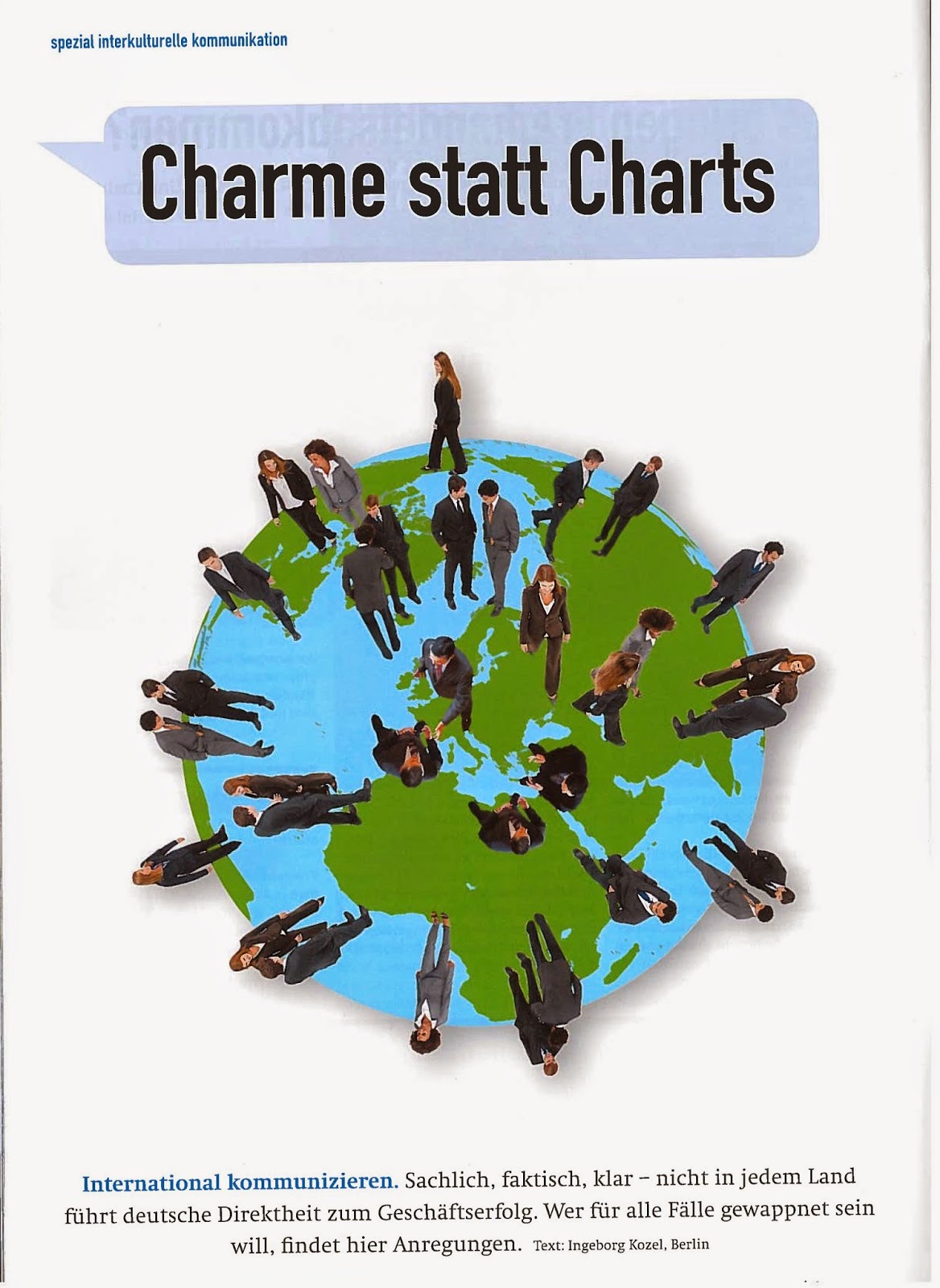
To summarize the German language article: Taking up cross cultural business relationships can comparable to
courtship in various cultures - different rituals may be required in different countries, and while Germans tend to be straightforward, good planners and drill down to the fact of the matter immediately, they should focus on small talk bonding more often, turn on their charm, and linger on the level of business relationships a little bit longer.
Cross cultural communication means respecting others' values and behaviours without bending over backwards.
Last but not least, - "What are you ssinking about?" https://www.youtube.com/watch?v=MLoYL-6Y6vg - a sense of humour helps to weather storms and navigate around cliffs in cross cultural collaboration.
Tuesday, June 12, 2007
Expertise, tools & innovation to tackle „Change Management“ - 1st milestones of associate work group reached
As we know nothing is as constant as change: the frequency of restructuring and change processes is rising – after the Change is before the Change.
On 12 June 2007, Dr. Dorothee Feldmüller, Dr. Jan Mütter and Dr. Katharina Kettner presented the topics that have been explored in the workgroup „Change Management“ since August 2006 at IT-Center Dortmund. The next group meeting will be on 31 August 2007 in Düsseldorf.
On 12 June 2007, Dr. Dorothee Feldmüller, Dr. Jan Mütter and Dr. Katharina Kettner presented the topics that have been explored in the workgroup „Change Management“ since August 2006 at IT-Center Dortmund. The next group meeting will be on 31 August 2007 in Düsseldorf.
Wednesday, May 19, 2004
2004 Pflege und Pflegewissenschaft - Ausbildung, Berufspraxis und Kultur im internationalen Vergleich
23.-27. Mai 2004 - London, UK
In einer Exkursion nach London entdeckt eine Studiengruppe der Ev. Fachhochschule Rheinland Westfalen Lippe die 'Roots of Nursing and Care Culture' mit Dr. Katharina Kettner.
 Die "Medical History Tour" umfasst interessante Themen wie "Operations without Anaesthetics" im Old Operating Theatre & Herb Garret, oder "The Early Hospitals", "Body Snatchers" im St Bartholomew's Hospital Museum in Smithfield
Neben kulturell orientierten Entdeckungsgängen durch die pulsierende Stadt - und natürlich auch Camden und andere Märkte ;), wird sicherlich ein besonderes Highlight das interkulturelle Erlebnis sein: Wie Kollegen in einem anderen europäischen Land leben und arbeiten, sowie der Vortrag über (universitäre) Ausbildung in Großbritannien "The provision of nurse education in the UK", Florence Nightingale College for Nursing and Midwifery, King's College.
In einer Exkursion nach London entdeckt eine Studiengruppe der Ev. Fachhochschule Rheinland Westfalen Lippe die 'Roots of Nursing and Care Culture' mit Dr. Katharina Kettner.
Die "Medical History Tour" umfasst interessante Themen wie "Operations without Anaesthetics" im Old Operating Theatre & Herb Garret, oder "The Early Hospitals", "Body Snatchers" im St Bartholomew's Hospital Museum in SmithfieldNeben kulturell orientierten Entdeckungsgängen durch die pulsierende Stadt - und natürlich auch Camden und andere Märkte ;), wird sicherlich ein besonderes Highlight das interkulturelle Erlebnis sein: Wie Kollegen in einem anderen europäischen Land leben und arbeiten, sowie der Vortrag über (universitäre) Ausbildung in Großbritannien "The provision of nurse education in the UK", Florence Nightingale College for Nursing and Midwifery, King's College.
Friday, January 16, 2004
Training & Coaching between cultures: Arts & Business, or What can business people learn from artists?
Around 20 leaders from Rhine and Ruhr came together for an interactive lecture concerning the question: "Arts & Business: What can business people learn from artists?" by Dr. Katharina Kettner of wave-concepts.

Usually these two contexts are thought of as "two separate worlds" but here they were explored for their cultural common grounds, transfer possibilities and value systems.
This meeting has not only been interactive because of the stimulating questions, and all participants sharing insights, but the rather special exercises.
An extraordinary highlight were the emerging synergetic light sculptures made - almost in silent consonance, as it were - from all the single light spots created by the participants.
Here, input, reflection and action combined into a new, direct experience.
Special Thanks to the Gabal-Team for their support and to IHK-Bochum (Bochum Chamber of Commerce) for the workshop space!
Usually these two contexts are thought of as "two separate worlds" but here they were explored for their cultural common grounds, transfer possibilities and value systems.
This meeting has not only been interactive because of the stimulating questions, and all participants sharing insights, but the rather special exercises.
An extraordinary highlight were the emerging synergetic light sculptures made - almost in silent consonance, as it were - from all the single light spots created by the participants.
Here, input, reflection and action combined into a new, direct experience.
Special Thanks to the Gabal-Team for their support and to IHK-Bochum (Bochum Chamber of Commerce) for the workshop space!
Training & Coaching zwischen den Kulturen: Arts & Business, oder Was können Geschäftsleute von KünstlerInnen lernen?
Unsere Gesellschaft ist im Umbruch: die wirtschaftliche Lage, die politische Situation, die Formen zwischenmenschlicher Interaktion verändern sich rapide und stellen die Menschen, die hier & heute leben, vor scheinbar ungekannte Herausforderungen.
Change Management Training, welches Methoden und ‚Strategien' isoliert vermittelt, greift angesichts dieser komplexen, dynamischen Realität zu kurz.
 Gefordert sind Ressourcen, die Mitarbeitern in Organisationen andere Fähigkeiten vermitteln oder Fähigkeiten anders vermitteln. Diese Ressourcen bietet die Kunst in idealer Weise.
Und weil wir finden, daß das Ruhrgebiet eine ideale Homebase für diesen Ansatz ist, erfahren Sie auch, warum.
Vortrag, Diskussion, ggfls. praktische Demonstration
Zeit: Freitag, 16. Januar 2004, 16.00 - 18.00 (im Falle einer praktischen Demonstration ggfls. 20.00)
Ort: IHK Bochum, (Industrie- und Handelskammer im mittleren Ruhrgebiet zu Bochum) Ostring 30-32, 44787 Bochum (Nähe Hbf)
Referentin: Dr. Katharina Kettner, wave-concepts
Change Management Training, welches Methoden und ‚Strategien' isoliert vermittelt, greift angesichts dieser komplexen, dynamischen Realität zu kurz.
- Welche Methoden und Fähigkeiten aus der Praxis von Künstlerinnen helfen Fach- und Führungskräften, den kommunikativen Herausforderungen in ihrer Organisation zu begegnen?
- Welche kulturellen Gemeinsamkeiten und Unterschiede lassen sich erkennen?
- Wie trägt ein interkulturelles Wertesystem in diesem Sinne zur Personalentwicklung bei?
- Wie können Teilnehmer diese Entwicklung nachhaltig in ihre Berufspraxis umsetzen?
Und weil wir finden, daß das Ruhrgebiet eine ideale Homebase für diesen Ansatz ist, erfahren Sie auch, warum.
Vortrag, Diskussion, ggfls. praktische Demonstration
Zeit: Freitag, 16. Januar 2004, 16.00 - 18.00 (im Falle einer praktischen Demonstration ggfls. 20.00)
Ort: IHK Bochum, (Industrie- und Handelskammer im mittleren Ruhrgebiet zu Bochum) Ostring 30-32, 44787 Bochum (Nähe Hbf)
Referentin: Dr. Katharina Kettner, wave-concepts
Subscribe to:
Posts (Atom)