Pop-up coaching is a one-off session of talking with a professional who may or may not be knowledgable in your field, but definitely knows about structures, has experience in corporate life and business and can be a sounding board and neutral advisor for your issues.
You are likely to benefit from a one-time coaching session if you want to..
- set goals in your personal and individual life and need some reinforcement
- check if you're on the right track with your goals and endeavours
- solve a conflict or dilemma that has come up in one of your projects or teams
- get a better grip on the changes happening in your organization, department, team or project, be it as a Sponsor or as an affected Stakeholder, or as a Change Management team
- test if coaching is something that may generally help you in your career, or find out if you are compatible with a particular coach
It is usually a low-risk investment of time and money that can pay off immensely.
Book a session to try it out!
Showing posts with label project. Show all posts
Showing posts with label project. Show all posts
Wednesday, March 27, 2019

Saturday, August 15, 2015
Why Enterprise Architects are vital for Change Management - Part 2: OCM & EA
Organizational Change Management assignments often occur in large IT transformations, which are normally devised, planned and implemented with the help of EA (Enterprise Architecture). How does that title relate to other organizational architecture job titles (I am linking to the wikipedia definitions for easy access, and as a starting point, however, some of them have improvement potential)? And what makes close cooperation with an Enterprise Architect invaluable for me as an Organizational Change Manager - in order to ensure the success of the project?

Business Architect - develops and aligns the business capabilities with corporate/business strategies & plans, frequently included in either EA or Sr. BA and/or OCM positions.
Solution(s) Architect - sometimes used as a synonym to EA, or acts as a go-between the strategic and operational players in programs, projects and architecture teams.
Software Architect, Applications Architect - basically the same, even though two different definitions exist in wikipedia. Lines up and aligns the landscape of applications in an enterprise.
Data Architect - defines and plans data storage, usage and management in systems and applications
Information Architect - does the same, additionally works with websites, intranet, taxonomies, and borders on the enterprise's knowledge management strategy.
A huge problem in transformation projects are legacy data, software, systems and, of course work processes.
Metaphor for the lay person: If you have a TV, sound system, video recorder, CD player, game consoles for TV and handheld (different ones for each child) and maybe even a record or cassette player, some of which are connected to your PC or MAC, and you look at the CDs, DVDs, records, floppy disks and the cable salad behind your unit, upscale it to a 1,000 - 10,000 people organization, you might get a feel for what technology resources are dealing with.
A huge problem for organizations is to divide up the architectural work before the project, since the terminology and the boundaries between fields can be fuzzy. In the projects that I've been assigned to, I mostly had to do with Enterprise Architects (rather than the other titles listed above).
I thoroughly enjoy working with Enterprise Architects, here's why:
When you hit the ground running on a new project, nobody can give you the low down on the lay-of-the-land as well as a good EA. Because (s)he has the eagle eye view, the EA can give you invaluable tips on peculiarities of this organization's specific environment regarding
- systems
- data
- processes, and, most importantly,
- stakeholders and sponsors
It won't take ages, because they can be as high-level as possible and as detailed as necessary. Enterprise Architects are usually pioneers and explorers, there is no better source for learning about technology and systems. A good EA knows tools & apps but is not fixated on them.
Ideally, they are sounding boards and communicators, too. Most of the time, Enterprise Architects don't object to - and even enjoy - follow-ups further into the project, listening to the people side of the change and discussing patterns, systems and strategies. And if the Enterprise Architect says "she gets me" or "awesome work", you know you're on the right track.
Why does that make the project successful? The organizational strategy and change strategy need to be aligned to create authenticity, and, at the end of the day, be believable to the users. When the Change Manager knows the high-level perspective it is always possible to get "into the weeds" from there, the requirements, the processes, the communications, the feelings of resistance etc. etc. etc. Vice versa? Not so much..
 Please do not hesitate to comment. Thank you.

Architecture job titles in blooming season
Enterprise Architect - plans & implements an organization's IT strategy. This may include all of the activities/designations below.Business Architect - develops and aligns the business capabilities with corporate/business strategies & plans, frequently included in either EA or Sr. BA and/or OCM positions.
Solution(s) Architect - sometimes used as a synonym to EA, or acts as a go-between the strategic and operational players in programs, projects and architecture teams.
Software Architect, Applications Architect - basically the same, even though two different definitions exist in wikipedia. Lines up and aligns the landscape of applications in an enterprise.
Data Architect - defines and plans data storage, usage and management in systems and applications
Information Architect - does the same, additionally works with websites, intranet, taxonomies, and borders on the enterprise's knowledge management strategy.
A huge problem in transformation projects are legacy data, software, systems and, of course work processes.
Metaphor for the lay person: If you have a TV, sound system, video recorder, CD player, game consoles for TV and handheld (different ones for each child) and maybe even a record or cassette player, some of which are connected to your PC or MAC, and you look at the CDs, DVDs, records, floppy disks and the cable salad behind your unit, upscale it to a 1,000 - 10,000 people organization, you might get a feel for what technology resources are dealing with.
A huge problem for organizations is to divide up the architectural work before the project, since the terminology and the boundaries between fields can be fuzzy. In the projects that I've been assigned to, I mostly had to do with Enterprise Architects (rather than the other titles listed above).
Close cooperation with Enterprise Architects to maximize success
When you hit the ground running on a new project, nobody can give you the low down on the lay-of-the-land as well as a good EA. Because (s)he has the eagle eye view, the EA can give you invaluable tips on peculiarities of this organization's specific environment regarding
- systems
- data
- processes, and, most importantly,
- stakeholders and sponsors
It won't take ages, because they can be as high-level as possible and as detailed as necessary. Enterprise Architects are usually pioneers and explorers, there is no better source for learning about technology and systems. A good EA knows tools & apps but is not fixated on them.
Ideally, they are sounding boards and communicators, too. Most of the time, Enterprise Architects don't object to - and even enjoy - follow-ups further into the project, listening to the people side of the change and discussing patterns, systems and strategies. And if the Enterprise Architect says "she gets me" or "awesome work", you know you're on the right track.
Why does that make the project successful? The organizational strategy and change strategy need to be aligned to create authenticity, and, at the end of the day, be believable to the users. When the Change Manager knows the high-level perspective it is always possible to get "into the weeds" from there, the requirements, the processes, the communications, the feelings of resistance etc. etc. etc. Vice versa? Not so much..

Saturday, August 8, 2015
Why Enterprise Architects are vital for Change Management - Part 1: What is EA anyway?
As a Manager of Organizational Change I have come to appreciate working with technology sources tremendously, in particular with Enterprise Architects. In my previous career as an expert for Organizational Communication & Development - working in lighthouse/pioneer projects and transitions of large corporate M&As long before this was even called change management - I had known IT people from some assignments facilitating teams, or teaching MBAs. When I got deeper into the IT world some 10+ years ago I remember thinking two thoughts:
 Taking the term 'Architect' as a metaphor might be helpful. An Architect plans & monitors the building process of a house, she needs to know about plumbing or electrician requirements, yet doesn't have to be a plumber or electrician herself (*or himself - men are obviously included ;). Of course some time way back in her learning phase there might have been an internship, apprenticeship or practical studies field.
I hear "Ask an expert" from the 3rd row. I am thus flinging this question to you, the experts among you. What criteria for skills and methods of Enterprise Architecture are indispensable to you, which parts do you value most? Is it more business or more techie or 50:50? How would you separate myth from reality? What are the obstacles in the daily routine? What difference does project management methodology contribute, scrum or waterfall?
- Wow. This is a completely separate culture within companies, much different from all other departments, you won't get anywhere in here without speaking what I affectionately call 'Geekspeak' (Watching 'The IT-Crowd' does help to overcome the culture clash, though..).
- And secondly, among my colleagues & friends or the (IT) Change Management Group at gpm-ipma, Germany's largest PM association, we absolutely agreed: If Change in Organizations goes wrong, it's almost always a "people problem".
I would like to reflect my view on this world back to you, maybe provide you with some fresh insights, and I'll start with the definition of Enterprise Architecture. There should really not be too many problems here, one could always look up wikipedia (how I dread the day I find out wikipedia is blatantly incorrect - always cross-check, boys & girls), or use common-sense.

Do companies know what to look for in an Enterprise Architect?
Flipping through companies' job postings, however, on the requirements side, one finds some must-haves that clearly display lack of ability to think on a metalevel. Partly, to be sure, because it makes measuring or filtering candidates' skills difficult.
Back to Enterprise Architects and the metalevel. If an EA only needs to know ABOUT administrating systems, writing code etc. how can one assess if her skills are enough for a sophisticated job such as planning a business, its processes and technology?
I hear "Ask an expert" from the 3rd row. I am thus flinging this question to you, the experts among you. What criteria for skills and methods of Enterprise Architecture are indispensable to you, which parts do you value most? Is it more business or more techie or 50:50? How would you separate myth from reality? What are the obstacles in the daily routine? What difference does project management methodology contribute, scrum or waterfall?
I'd appreciate your input, to get a discussion going. Cheers!
And since I love thinking in terms of questions, here are the ones the next part(s) will revolve around: How does Enterprise Architecture relate to the many other Architecture job titles that seem to be in blooming season? Solution(s) Architect, Data Architect, Information Architect, Business Architect.. And what makes it invaluable for Change Managers to work closely with Enterprise Architects to ensure the success of the project?
Tune in..
Sunday, March 15, 2015
Intercultural Competences in Change Management
Intercultural Competences in Change Management
Try Charms, not Charts
Today's projects are often made up of international members. And while collaboration has a fair chance when international people of the same designation work together, problems multiply when the road gets rocky, which is not altogether unlikely in Change Projects.
This article contains an interview with me on best practice tips to avoid pitfalls intercultural business communication.
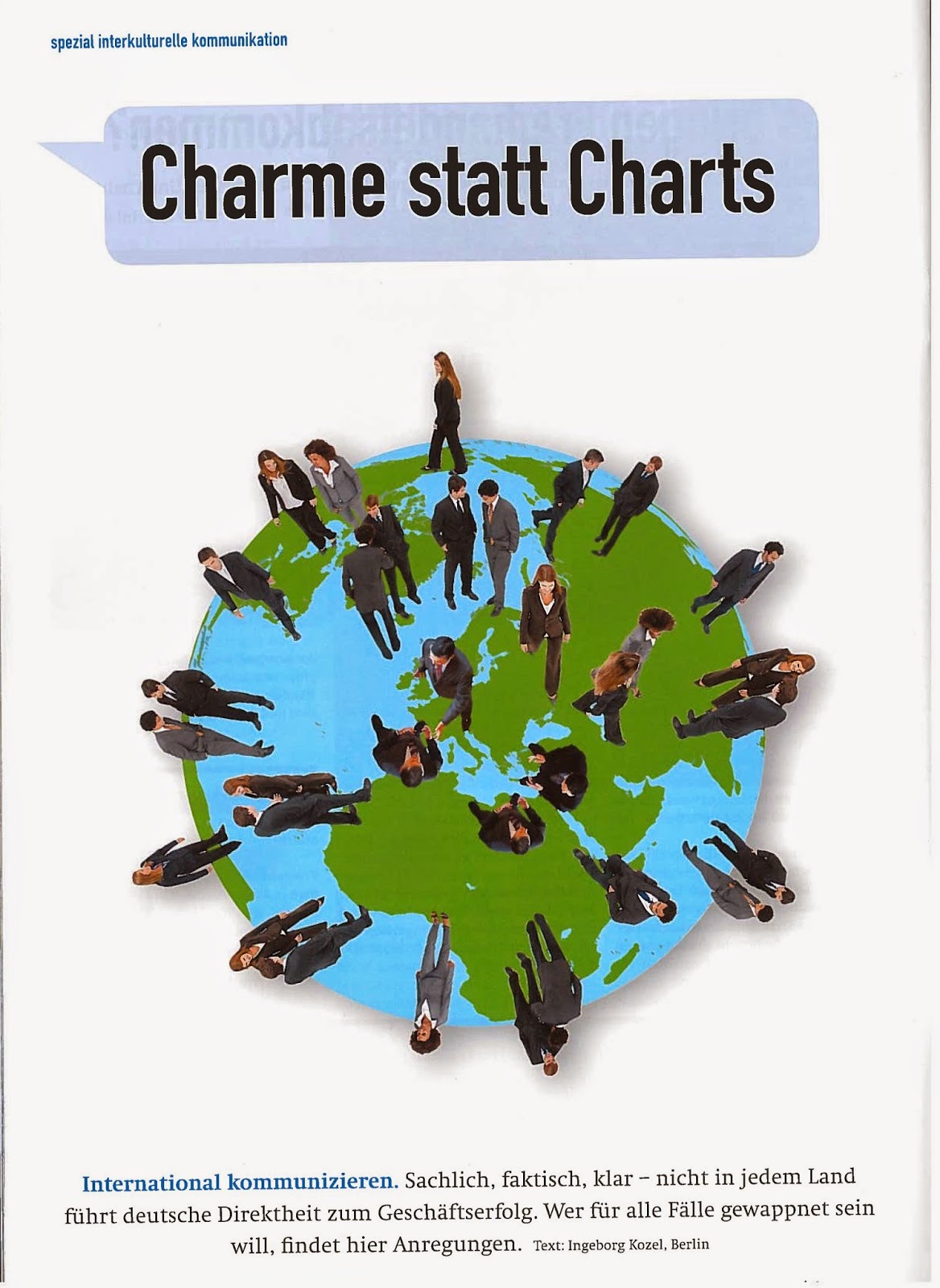
To summarize the German language article: Taking up cross cultural business relationships can comparable to
courtship in various cultures - different rituals may be required in different countries, and while Germans tend to be straightforward, good planners and drill down to the fact of the matter immediately, they should focus on small talk bonding more often, turn on their charm, and linger on the level of business relationships a little bit longer.
Cross cultural communication means respecting others' values and behaviours without bending over backwards.
Last but not least, - "What are you ssinking about?" https://www.youtube.com/watch?v=MLoYL-6Y6vg - a sense of humour helps to weather storms and navigate around cliffs in cross cultural collaboration.
Wednesday, July 9, 2014
World Cup 2014 Semi-Final - Learning points for OCM
Germany - Brazil 7-1, a spectacular match - What can we learn from it?
Like in the corporate world, the pressure is on. Because they are condensed to the max, and success and failure are so measurably apparent, joint efforts such as football matches - and music concerts - serve as good examples on how we do in Organizational Change and what the big points are.
Agility & Team spirit
From the beginning right through to the very end the German players were agile and purposeful, they kept eye contact with the others on the team, they were able to let go and pass the ball to a team-mate in orchestrated choreographies, each team member doing their part but also keeping an eye out for the whole.For a change project in the corporate environment this means that the information flow needs to keep going. Communication channels within the project / project office have to have the necessary definition to spur purposeful action, and at the same time enough openness to keep the teams motivated.
Even in large corporate companies, or even in Tech Consultancies, as many colleagues have confirmed in 'shop talks', there is often no - or not enough - culture of communicating with each other, and social/knowledge management apps are often merely a sad document grave.
And if this is in the change project teams themselves - how can the word be spread out to the company?
Freedom & Responsibility
Teams need leeway to act on opportunities & synergies, in football and in corporate life. Overcautious micro-management only displays lack of trust, and kills motivation and 'enablement'.Participative leadership means team players can grasp opportunities, or create synergies, in OCM for example with SMEs, or the communications or organizational development departments, to optimize success.
It also means they will be able - and willing - to take responsibility and take charge of emerging needs. In the semi-final for example, the 3-0 was scored, because ".. There are lots of defenders in there but nobody is taking responsibility to pick anyone up." (Rio Ferdinand, in the BBC Analysis of the match).
Strategy & "Setting the Course" from the get-go
First of all: Having a Strategy is good. Change has become such a big issue, spanning whole organizations, so it becomes more and more apparent that OCM, as well as Organizational Communication & Culture are STRATEGIC issues. Yes, the ROI is not as easily measured as the goals and chances in football, but if you look at any successful initiative they will have had a STRATEGY on change and company culture, and, what's more important, they will have ACTED ON IT.There is nothing like setting the course from the get-go - in our example scoring 5 goals in the first 29 minutes - to boost the morale of a team, because it takes pressure off the players. Aligned with the overall strategy, this move is likely to foster more success.
In change initiatives, the OCM Lead is often brought in 6, 8, 10 months into the initiative. This does not only not save money, as intended, it also looses the strategic point and the chance to boost motivation on the project tremendously.
Leadership & Lack of Leadership
The 5-0 in our example was scored due to lack of leadership in the other team: ".. the captain, supposed to be the leader, .. has abandoned ship I am afraid. He has disappeared." (Alan Hansen), and "That is embarrassing. When you do that, you are leaving your team-mates in the lurch. As a centre-half, he has to win the ball there." (Rio Ferdinand)Much more could be said here, watch this spot for blog posts on Leadership topics.
Don't give up
From many examples we know about "not giving up when times get rough", and Oscar's goal in the last minute is one strong demonstration.However, "not giving up when things go well" is also important. How many times have teams felt safe and leaned back into complacency. And then lost
DO IT
Football is not rocket science. Change Management is not rocket science. What a facebook friend commented on as "the unrelenting efficiency of the German team" is merely doing what is known to work. To the last consequence.Yes, it takes creativity, yes, it takes the magic of the moment. Like jazz improvisation.
And like jazz improvisation, that too, can be learned. But most of all it takes a team.
And, yes, especially in this moment, I am proud of having grown up in a culture where there is a notion of "doing the right thing" - effectiveness, and "doing things right" - efficiency.
Success factors of Organizational Change Management are out there, and one just has to take them seriously and act on them. More on this in my next posts.
Thanks for your time, feel free to comment!
All quotes are from http://www.bbc.com/sport/0/football/28221160, the BBC Analysis of the match.
Tuesday, July 10, 2007
Competitive edge in Diversity: Female project management experts take off
On 09 July 2007, Entrepreneuresses and female project managers from all over Germany met at the Frankfurt “Cosmopolitan” on invitation of Roswitha Müller-Ettrich (Munich, founding member and Head of the Board of Trustees of the GPM, (German project management association-IPMA) and Dr. Dorothee Feldmüller (Bochum, IT-project management and consulting; Leaders’ Team of GPM Chapter Dortmund).
Dr. Katharina Kettner took part in the newly founded GPM work group as an associated expert for Diversity and Inclusion.
Strategic objective is the creating space for themes of gender within project management, and will be basis for enhancing collaboration and effectiveness in project management work by diversity, as well as tackling questions of marketing achievements, image and profile, for example by means of success stories.
Talking about successes and failures is an important element of future oriented management. Diversity belongs to the field of intercultural competencens, by which added value can be improved in many projects. Contrarily, ignoring cross cultural differences not only wastes nerves, but also assignments, time and money.
Dr. Katharina Kettner took part in the newly founded GPM work group as an associated expert for Diversity and Inclusion.
Strategic objective is the creating space for themes of gender within project management, and will be basis for enhancing collaboration and effectiveness in project management work by diversity, as well as tackling questions of marketing achievements, image and profile, for example by means of success stories.
Talking about successes and failures is an important element of future oriented management. Diversity belongs to the field of intercultural competencens, by which added value can be improved in many projects. Contrarily, ignoring cross cultural differences not only wastes nerves, but also assignments, time and money.
Friday, January 16, 2004
Training & Coaching between cultures: Arts & Business, or What can business people learn from artists?
Around 20 leaders from Rhine and Ruhr came together for an interactive lecture concerning the question: "Arts & Business: What can business people learn from artists?" by Dr. Katharina Kettner of wave-concepts.

Usually these two contexts are thought of as "two separate worlds" but here they were explored for their cultural common grounds, transfer possibilities and value systems.
This meeting has not only been interactive because of the stimulating questions, and all participants sharing insights, but the rather special exercises.
An extraordinary highlight were the emerging synergetic light sculptures made - almost in silent consonance, as it were - from all the single light spots created by the participants.
Here, input, reflection and action combined into a new, direct experience.
Special Thanks to the Gabal-Team for their support and to IHK-Bochum (Bochum Chamber of Commerce) for the workshop space!
Usually these two contexts are thought of as "two separate worlds" but here they were explored for their cultural common grounds, transfer possibilities and value systems.
This meeting has not only been interactive because of the stimulating questions, and all participants sharing insights, but the rather special exercises.
An extraordinary highlight were the emerging synergetic light sculptures made - almost in silent consonance, as it were - from all the single light spots created by the participants.
Here, input, reflection and action combined into a new, direct experience.
Special Thanks to the Gabal-Team for their support and to IHK-Bochum (Bochum Chamber of Commerce) for the workshop space!
Subscribe to:
Posts (Atom)